
Introduction
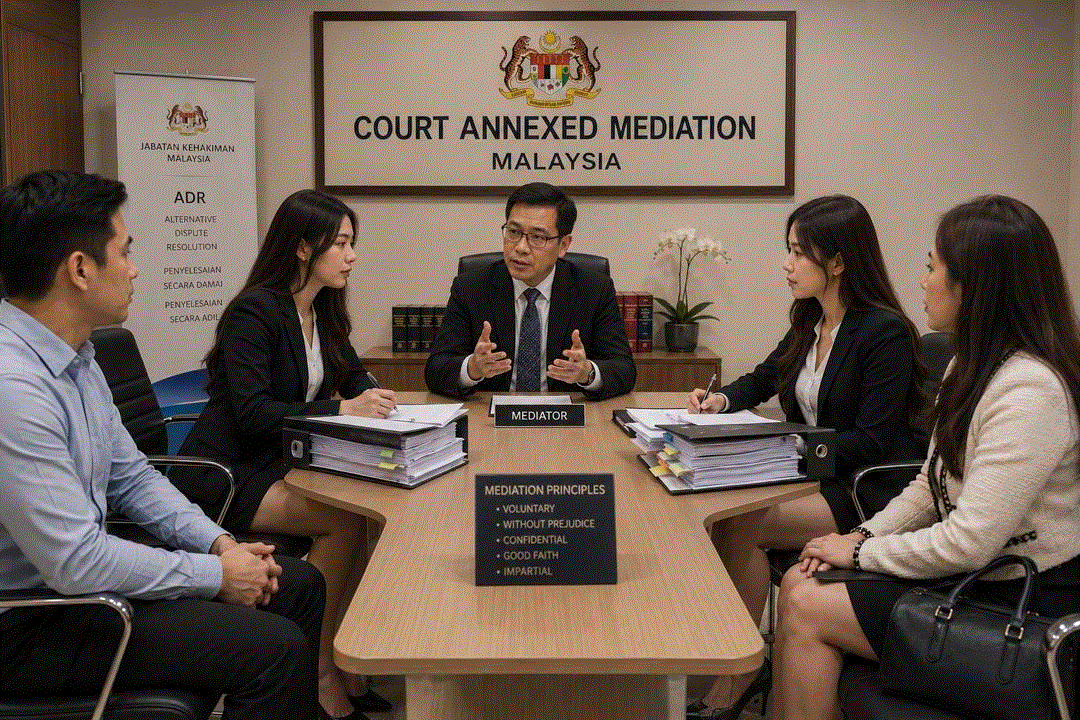
1. Alternative dispute resolution (ADR) has become an increasingly important feature of the Malaysian legal system. Among the various forms of ADR, court-annexed mediation is widely encouraged as a means of resolving disputes efficiently while preserving the relationship between the parties.
Best of both worlds of the legal system
2. Court-annexed mediation in Malaysia is governed primarily by Order 34 Rule 2 of the Rules of Court 2012 (ROC 2012), which empowers the court to direct parties to facilitate settlement, and by the Mediation Act 2012 (Act 749), which provides the legal framework governing mediation proceedings, confidentiality, and settlement agreements. Together, these provisions ensure that mediation remains a confidential and party-centred process while preserving judicial neutrality.
Roles of judges in court-annexed mediation
3. The judge conducting court-annexed mediation acts primarily as a neutral facilitator rather than an adjudicator. The objective is not to determine who is legally right or wrong but to assist the parties in communicating effectively, identifying the real issues in dispute, and exploring practical solutions that may satisfy both sides.
Flexibility of court-annexed mediation
4. Order 34 Rule 2 of the Rules of Court 2012 empowers the court to encourage settlement at any stage of proceedings, reflecting the judiciary’s policy that litigation should not always be the first or only avenue for resolving disputes and Order 34 Rule 2(1A) of the Rules of Court 2012, the judge may refer the parties to mediation if it is found out an issue arising in the action on proceeding between the parties can be resolved by way of mediation
Voluntary basis
5. During mediation, the judge facilitates discussions, encourages compromise, and assists parties in evaluating the strengths and weaknesses of their respective positions without imposing any decision upon them. Mediation Act 2012 reinforces the principle that mediation is voluntary.
Mediator is usually not the presiding judge
6. The judge’s impartiality remains essential throughout the mediation process. Where mediation is unsuccessful, the matter ordinarily proceeds to trial before another judge where practicable, ensuring that confidential discussions during mediation do not prejudice subsequent judicial proceedings. This separation maintains public confidence in the fairness and integrity of the judicial process.
7. Court-annexed mediation generally begins with counsel presenting the dispute to the mediator. Lawyers provide an overview of the legal issues, relevant facts, and their client’s position. This opening session allows the mediator to understand the nature of the dispute and identify the key obstacles preventing settlement.
8. The opening statements further enable the mediator to establish the ground rules of mediation, including confidentiality, respectful communication, and the voluntary nature of the process. This structured beginning creates a constructive environment where negotiations can proceed effectively.
9. The involvement of lawyers at this early stage is particularly important because any eventual settlement must be legally enforceable. Counsel therefore help ensure that discussions remain realistic and that clients understand the legal consequences of any proposed agreement.
Private caucuses sessions
10. After the joint opening session, the mediator commonly conducts private caucuses, where each party meets separately with the mediator, usually WITHOUT the presence of their legal counsel. Usually the counsel would be excused from this private caucuses between the client and the mediator.
11. The private caucus is one of the most valuable aspects of mediation because it provides a confidential environment in which parties can openly express concerns, frustrations, and underlying interests that they may hesitate to reveal during a joint meeting. Rather than focusing solely on legal rights, the mediator explores the parties’ commercial interests, personal concerns, future relationships, and practical objectives.
12. Confidentiality is a cornerstone of this stage. Sections 15 and 16 of the Mediation Act 2012 protect communications made during mediation from disclosure or admissibility in subsequent court proceedings, subject to limited statutory exceptions. This statutory protection encourages honest and candid discussions without fear that admissions made during negotiations will later be used against a party in court.
13. Following the private discussions, the parties and their counsel reconvene for the final joint session. At this stage, lawyers play an essential role in translating the negotiated understanding into legally enforceable terms.
Finalisation of terms of settlement
14. Where an agreement has been reached, counsel assist in drafting the settlement agreement or, where appropriate, preparing a consent judgment capable of being recorded by the court. Section 13 of Mediation 2012 recognises settlement agreements reached through mediation and allows them to be reduced into writing and signed by the parties. Once properly executed, the agreement becomes binding upon the parties and may subsequently be enforced according to law. Where mediation takes place within existing court proceedings, the settlement may also be recorded as a consent judgment.
15. If no settlement is achieved, the mediation simply concludes without prejudice to either party’s legal rights. The matter then proceeds through the ordinary litigation process usually before another judge under the Rules of Court 2012.
Conclusion
16. In my personal opinion, court-annexed mediation is a valuable mechanism that promotes a more efficient approach to resolve disputes in Malaysia. The structured process allows lawyers to provide the necessary legal guidance while giving parties the opportunity to communicate openly and reach a solution that best meets their interests. The confidentiality protections under the Mediation Act 2012 further encourage honest negotiations, making settlements more achievable. Although mediation is not suitable for every case, particularly where parties are unwilling to compromise, I believe it plays an important role in reducing litigation costs, easing the courts’ workload, and encouraging amicable dispute resolution.
Clement Tee Yi Han



Sort Comments